Teaching social skills sounds all appealing, so when I read this paper, I was super excited. Essentially, this article introduced the empirical backgrounds, research, and procedure of TIP that any practitioner can follow. Great Information.
Social skills are complex phenomena and are often more difficult to teach than other skills typically targeted for individuals diagnosed with
ASD (Taubman et al., 2011). There are an increasing number of procedures or techniques available to the interventionist to help teach these complex skills (the existence of this book is a perfect example of this increase). These procedures include but are not limited to, Social Stories™ (Gray, 2004), social scripts (e.g., Loveland & Tunali, 1991), TIP (Phillips et al., 1968), BST (Miltenberger, 2008), pivotal response training (PRT; Koegel et al., 1989), and video modeling (e.g., Charlop & Milstein, 1989).
My go-to has been Social Narratives- easy to make, and can be delivered in multiple settings. Video modeling is also one of my favorite.
With respect to the development of social repertoires, one evidence-based intervention is the teaching interaction procedure (TIP; Leaf
et al., 2015b; Phillips et al., 1968), which consists of a multistep, systematic teaching procedure.
This sounds awesome! Like BST, I like TIP will guide me with steps and procedures with a room for flexibility.
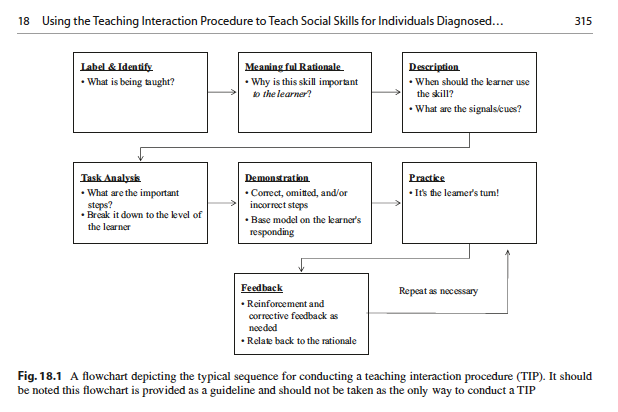
Through videotape analyses, it was determined that the couple described and demonstrated necessary skills, provided reasons that the skills were important to the young residents’ future success, and had the youth practice the skills while specific feedback was provided. The TIP was implemented within a one-to-one instructional format, and the effects were measured through naturalistic probes.
Subsequently, the TIP has been included in curriculum books,
such as Crafting Connections (Taubman, Leaf, & McEachin, 2011), and training manuals, such as Effective Skills for Child-care Workers: A Training Manual from Boys Town (Dowd, Czyz, O’Kane, & Elofson. 1994), and The ASSET Manual (Hazel, Schumaker, Sherman, & Sheldon-Wildgen, 1983). Although the steps of the TIP typically occur in the same order in these publications, as well as in practice, the order should be viewed as a guideline and the interventionist should remain flexible and modify as needed.
In contrast, BST does not include meaningful rationales as a core component but, instead, focuses solely on the use of instructions, modeling, rehearsal, and feedback (Miltenberger, 2008) to achieve the desired change in behavior.
Furthermore, the two features that distinguish the TIP from BST are the inclusion of rationales and teacher modeling of correct and incorrect skill performance;
However, the TIP may not be well suited for all learners. Although the research is lacking in identifying which component skills are necessary
for the TIP to be an effective teaching tool, some component skills should most likely be developed prior to using the TIP. First, given the exchanges that occur between the interventionist and the learner(s), some basic and/or intermediate conversation skills (e.g., commenting, responding to comments, answering open-ended questions; Leaf, & McEachin, 1999) and interaction skills (e.g., following the lead of another, social problem solving; Taubman et al., 2011) may be necessary. Second, even brief TIPs can require the learner to attend for rather long durations, so sustained attending may also be a necessary skill prior to using the TIP. Third, Taubman et al. (2011) discussed the need for a basic understanding of cause and effect relationships (e.g., turn the light off/the room is dark, drop an egg/ the egg shell is broken; Leaf, & McEachin, 1999) as a prerequisite for the TIP. This understanding is demonstrated by the learner stating why an outcome occurred (e.g., “The egg is broken because it fell on the floor”) and may be necessary for comprehending rationales as well as the relationships between role-play, employment of learned skills in everyday situations, and resultant changes in outcomes; therefore, this repertoire is also likely to be an important prerequisite before utilizing the TIP to teach social skills.





 Everyday Teaching Autism Resources
Leave a reply to Social Skills with Autism – Ms. Min's Resources Cancel reply