How to work with multiple students at once
This has been one of the most popular questions in my circle. We are teachers for students with severe behavior and cognitive challenges.
Many of the school instructions were planned out in small groups or a one-to-one setting. Each student has an IEP (individualized educational plan), so it makes sense to teach him or her in a one-to-one setting. Several studies also indicate that small-group instruction can be effective for individuals with autism, especially when used with other empirically validated teaching methods such as choral responding and direct instruction.
In the 6 and half-hour of the school day, a special education teacher has to run several small groups and coordinate with one-to-on instructions throughout the day. Yes, it’s a lot of planning and exhausting. If possible, I like to alternate different types of activities every 30 minutes or an hour.
Small group instruction typically groups 3 to 5 children together on the basis of similarity in a particular skill domain such as academic, language, or social skills for small group instruction. If grouped right, students would benefit from peer modeling and/or imitating each other’s on-task behavior(actions), taking turns, waiting, or responding in unison.
Between small group instruction and one-to-one instruction, these varied teaching formats will give our students a chance to work in various settings to work on independence as well. Some of the small group instructions may look like this…
One on One work time

I found it easier to have my student on my left side. Since I am right-handed, my hand is not in the way all the time. I work with a student in this setting for reading and math instructions with specific IEP goals that can’t be run in a small group.
Small Group Time w/ one adult support
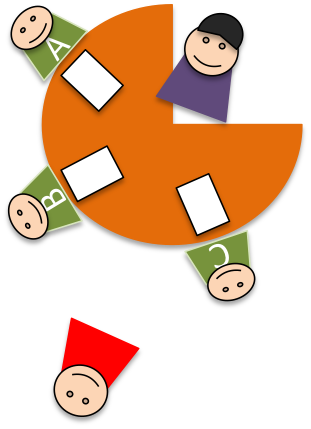

3-4 students with 2 adults
While a teacher is leading a group, make sure other paraprofessionals don’t overly give verbal prompts to students! From the student’s perspective, it must be so confusing when so many adults give directions at the same time. Sensory overload!
Place a student who requires more of hand over hand support in spot A. This will enable a teacher to help the student easily, while the aide helps the other two when it comes to completing some individual assignment.
In this setting, you can easily place another child at the table. 4:2. However, I would run a cooking activity or read simple adaptive books in which students are highly motivated and can easily participate in the most independent manner.





 Everyday Teaching Autism Resources
Leave a comment